A university client asked me to look at a batch of invention disclosures sitting in their tech transfer office and tell them what's actually licensable, what's still years from a first conversation with an industry partner, and where the portfolio's real leverage is. That's a common ask, and it's also a request that's easy to answer badly. A shallow version of this engagement reads the abstracts, guesses at market size, and hands back a slide deck ranking inventions by how exciting they sound. A rigorous version starts somewhere much less glamorous: the actual patent cover pages. Here's what the real process looks like, and the one finding that shows up in nearly every portfolio and routinely gets missed.
Start with the documents, not the summaries
Technology transfer offices maintain their own tracking systems, and those systems are useful for context but not reliable as a legal record. A listing that shows a provisional application as "Granted," or a status field with no application number behind it, tells you what someone typed into a database at some point, not what the patent office actually did. The only reliable source for filing status, application numbers, and, critically, who owns the rights is the filing itself.
That sounds obvious, but it has real workflow consequences. WIPO PCT publications, the international filings that most university disclosures pass through, come packaged as PAMPH files, which are ZIP archives of scanned page images, not searchable text PDFs. Granted US patents and published applications are frequently the same: scanned documents with no text layer. You can't skim these. You extract the archive, render the cover page, and read it directly, patent by patent, disclosure by disclosure. For a portfolio of any real size, that's not a fast step, and skipping it in favor of the TTO's summary spreadsheet is the single most common shortcut that produces a wrong assessment later.
The finding that matters most, and gets missed most
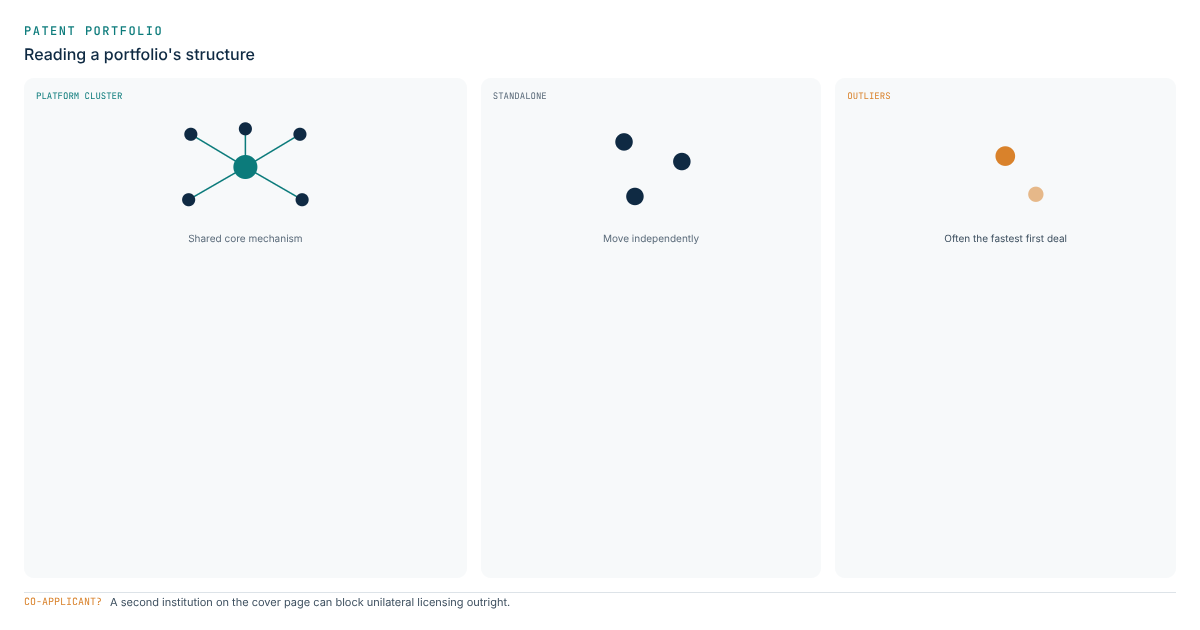
Here's the concrete lesson worth naming directly, because it's not abstract and it's not rare: a co-applicant institution that isn't the client's own tech transfer entity can block unilateral licensing outright. If a filing lists a second university, a hospital system, or another research institution as a co-applicant or co-assignee, your client does not have unilateral authority to license that technology to anyone. They need that other institution's agreement, and depending on the inter-institutional agreement in place (or the absence of one), that can mean anything from a straightforward revenue-sharing arrangement to a genuine standoff that stalls a deal for a year or more while lawyers on both sides negotiate terms neither party anticipated needing.
This is exactly the kind of fact that a summary-level review misses, because it lives on the patent cover page, not in the abstract, and not always in the TTO's own tracking sheet. It's also worth knowing that US filings have a formality that trips people up here: individual inventors are frequently listed alongside the institution in the applicant field, while a separate assignee field names the institution alone. That's routine and doesn't mean co-ownership. What actually determines licensing authority is the assignee field and, for international filings, the applicant field on the WO cover page, read directly, not inferred from an inventor list. Confusing the two in either direction, treating an inventor listing as a co-ownership claim, or missing an actual co-applicant because the summary document didn't flag it, produces an assessment that's wrong in a way that only surfaces once a deal is already in motion. That's the worst time to find out.
The practical fix is procedural, not clever: verify co-applicant status against the actual patent cover page for every single disclosure before producing any deliverable, full stop, no exceptions for disclosures that "look" clean from the summary. It's tedious. It's also the check that prevents you from handing a client a licensing recommendation for an asset they can't actually license on their own.
Estimating where a technology actually stands
Once ownership is verified, the substantive assessment runs across a handful of dimensions for every disclosure: technology readiness level on the standard 1-9 scale, IP position (filed, pending, or lapsed, and whether a PCT filing exists), regulatory pathway target, and a separate, explicit confidence rating on that pathway, because "targeting a 510(k)" is a strategy the inventors have chosen, not a fact FDA has confirmed. Those are different claims, and conflating them is one of the most common ways an early-stage assessment overstates maturity. A pathway only earns "FDA confirmed" status after a Pre-Submission or formal classification request; everything short of that gets labeled aspirational, however reasonable the team's assumption might be.
Layered on top of that: whether the underlying material or device architecture has a cleared FDA predicate at all. No predicate means the practical pathway is De Novo or PMA rather than 510(k), which is a materially different regulatory and capital story, and it's a finding that belongs in the executive summary, not buried three pages into a technical writeup. Where relevant, that also means recommending a Q-Sub with FDA before any partner conversation goes past an NDA, because walking into a licensing discussion with an unconfirmed regulatory pathway and calling it confirmed is a credibility problem waiting to happen.
Market and commercial framing rounds out the picture: quantified market size and growth figures where a defensible source exists, explicit acknowledgment of the gap where one doesn't (research houses routinely disagree on scope by an order of magnitude, and picking one number without noting that is its own kind of overstatement), and a tiered map of potential licensing partners built from actual strategic fit rather than a generic list of "big companies in the space." Whether the disclosure fits into a broader platform, sharing a core mechanism with other filings in the same portfolio, or stands alone, matters here too: platform technology licenses on different terms than a single-application patent, and mislabeling a platform asset as standalone leaves real value on the table in a negotiation.
The part that surprises inventors
Two things routinely catch inventors off guard when this work gets presented back to them. First, provisional patent applications carry a hard twelve-month deadline to file a PCT application or go straight to a US non-provisional, and that window closes quietly. A portfolio audit that tracks every filing date against its deadline, sorted by urgency, regularly turns up a disclosure with weeks left on the clock, sometimes one that's already lapsed into US-only coverage without anyone flagging it. When a window has already closed, the next question is whether the realistic buyer set for that technology is domestic or international, because that's what determines whether the loss is a rounding error or a real commercial setback.
Second, not every disclosure needs FDA involvement at all. Research-use-only instruments, certain software and image-processing tools, and a handful of other categories fall outside device regulation entirely. In portfolios weighted toward research tools, that's often true for a majority of the disclosures, and it's a genuine commercial advantage that gets undersold because most people, including a lot of experienced tech transfer staff, assume university medical technology IP is regulatory-heavy by default.
What the client actually gets
The output isn't a single ranked list. It's a structured picture: which disclosures form a platform cluster worth licensing as a bundle, which stand alone and can move independently, which are genuine outliers with no strategic connection to the rest of the portfolio (often, counterintuitively, the fastest path to a first deal, precisely because they don't require coordinating a broader licensing strategy), a regulatory landscape assessment naming pathway confidence and predicate gaps disclosure by disclosure, and a tiered partner map built around actual strategic fit rather than name recognition. And, just as important as what's included, an explicit accounting of what couldn't be established: an unverifiable IP status, a market figure with no defensible source, a co-applicant relationship that needs a direct conversation with the other institution before anyone can move forward. An assessment that quietly omits its own gaps reads as more complete than it is. Naming them is part of the deliverable, not a caveat tacked onto the end of it.
None of this is exotic work. It's methodical, and most of the value comes from doing the unglamorous verification steps in the right order rather than skipping to the exciting part. The co-applicant check alone, run properly before anything else gets built, has been the difference between a licensing recommendation the client can actually act on and one that quietly falls apart the first time a deal term sheet gets drafted.